Soil Testing Services & Laboratory
Professional laboratory testing to evaluate soil bearing capacity, California Bearing Ratio (CBR), Proctor compaction, Atterberg limits, direct shear strength, and permeability for structural foundations and road infrastructure.

GEOTECHNICAL & FOUNDATION SOIL TESTING
Soil Testing Services & Laboratory
Professional laboratory testing to evaluate soil bearing capacity, California Bearing Ratio (CBR), Proctor compaction, Atterberg limits, direct shear strength, and permeability for structural foundations and road infrastructure.
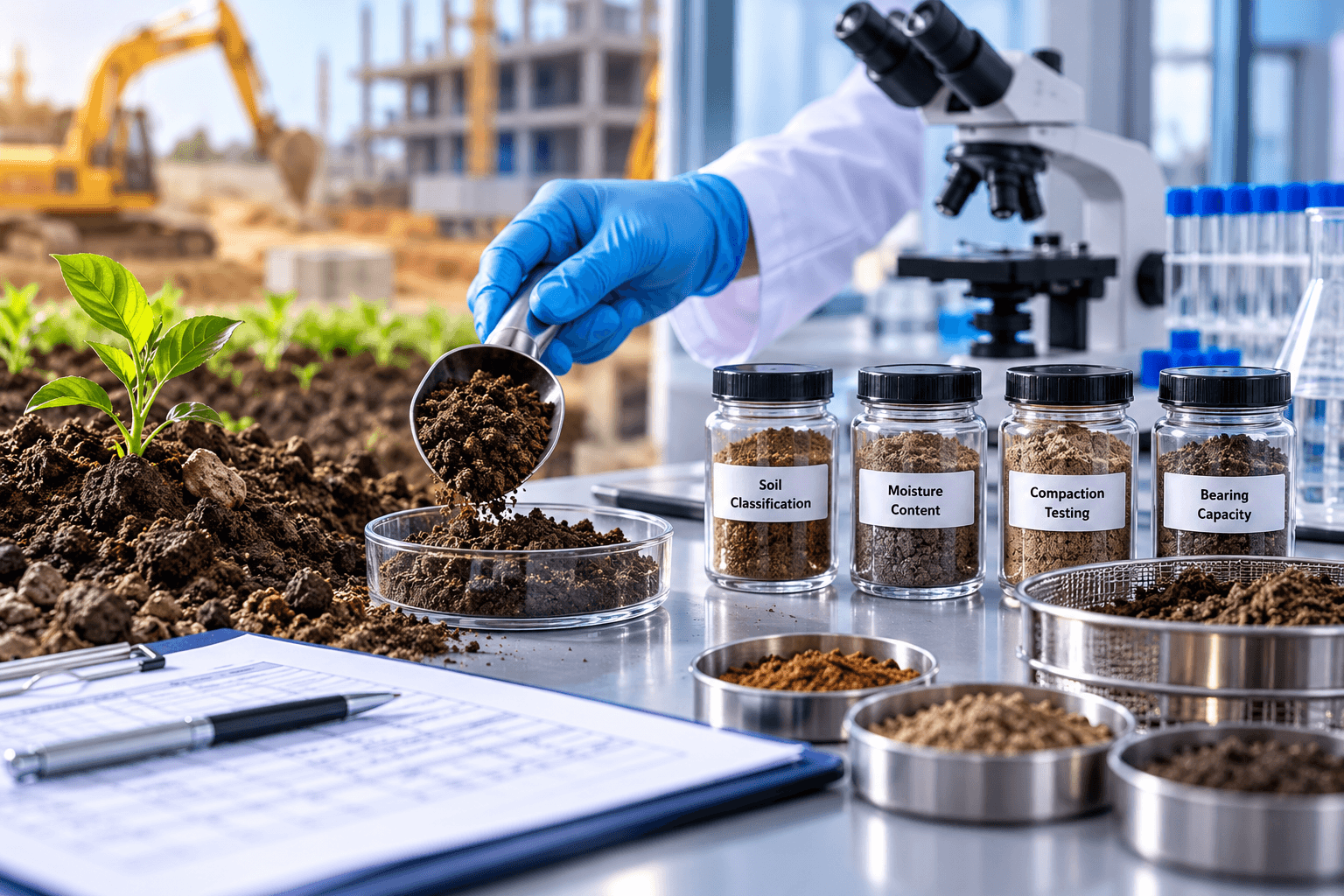
Professional Geotechnical Soil Evaluation Laboratory
Our laboratory provides reliable soil testing services to analyze the physical, mechanical, and hydraulic properties of subsoil strata required for building foundations, highway alignments, bridges, and infrastructure earthworks.
Subsoil conditions govern foundation stability and settlement risks. We conduct standardized evaluations including California Bearing Ratio (CBR), Proctor compaction, Atterberg plasticity limits, direct shear, consolidation, and permeability as per published standard geotechnical methods, enabling structural engineers to design safe, cost-efficient foundations.
Reliable
Testing Services
Advanced
Testing Equipment
Quality
Test Reports
Our Comprehensive Soil Testing Services
Standardized physical, mechanical, and geotechnical evaluations performed under controlled laboratory conditions.
Grain Size Analysis & Hydrometer
Determines particle size distribution from coarse gravel down to fine silt and clay fractions using mechanical sieves and sedimentation hydrometer tests as per standard sedimentation and sieve analysis procedures.
Atterberg Limits (LL & PL)
Measures liquid limit via Casagrande apparatus, plastic limit, and plasticity index (PI) to classify fine-grained soils and forecast swelling or shrinkage as per standard Atterberg limit procedures.
Standard & Modified Proctor Test
Evaluates compaction characteristics to establish Optimum Moisture Content (OMC) and Maximum Dry Density (MDD) for structural earth fills as per standard laboratory compaction procedures.
California Bearing Ratio (CBR)
Measures subgrade penetration resistance under soaked (4-day immersion) and unsoaked conditions to design flexible highway pavement thicknesses under standard soaked and unsoaked penetration protocols.
Direct Shear & Shear Strength
Evaluates cohesion (c) and angle of internal friction (φ) on consolidated drained specimens under varying normal stresses for foundation stability under standard direct shear testing procedures.
Unconfined Compressive Strength (UCS)
Measures axial compressive strength of cohesive soil cylinders to estimate undrained shear strength and safe bearing capacity rapidly under standard unconfined compression methods.
Permeability (Constant / Falling Head)
Measures hydraulic conductivity to evaluate drainage efficiency, seepage velocity, and dewatering requirements in foundation excavations under standard falling and constant head permeability protocols.
Consolidation & Settlement Properties
Measures compression index (Cc) and coefficient of consolidation (Cv) on oedometer cells to predict magnitude and rate of structural building settlement under standard one-dimensional oedometer test methods.
Specific Gravity & Moisture Content
Determines true soil grain density using calibrated pycnometers alongside rapid oven-dry moisture determination essential for all geotechnical calculations under standard pycnometer and oven-drying methods.
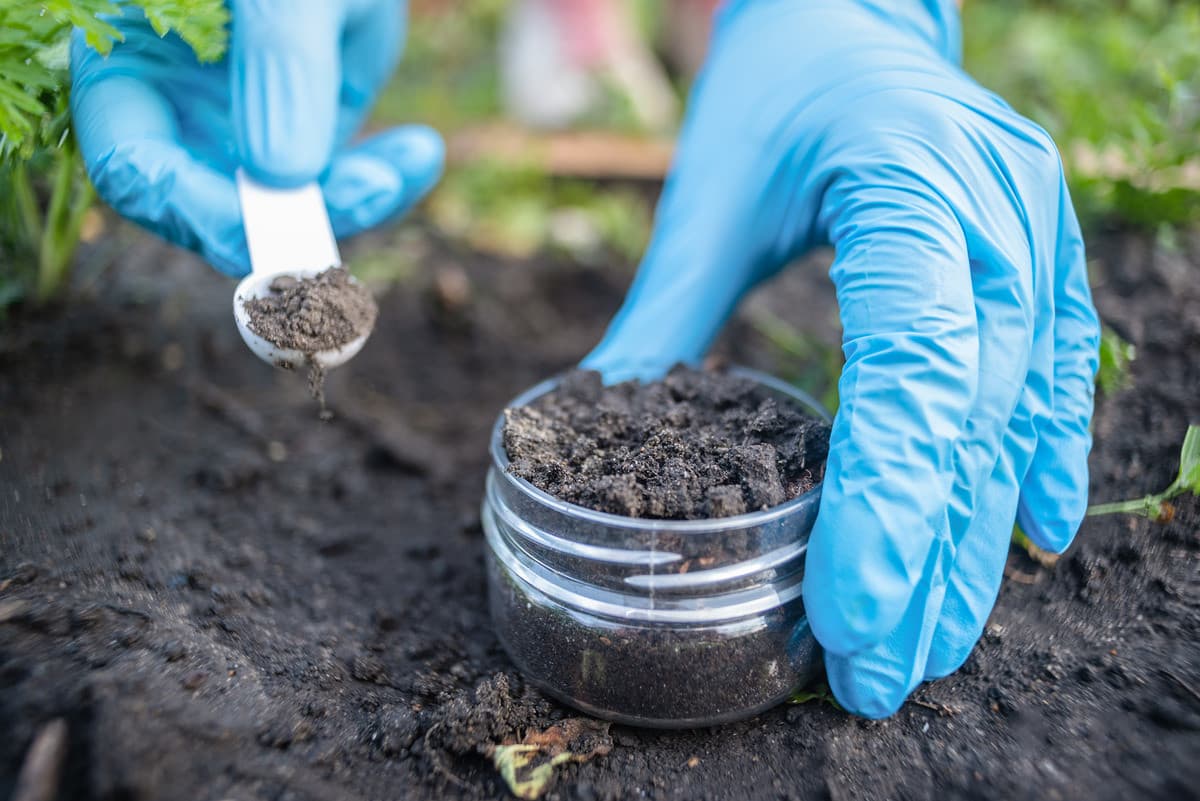
Soil Testing for Structural Foundations, Highways & Earthworks
Our geotechnical testing services support residential high-rises, expressway embankments, industrial plants, and foundation slope stability. Laboratory evaluation provides the exact bearing capacity, settlement rates, and subgrade CBR required for secure engineering designs.
Building Footings
Safe Bearing Capacity
Highway Subgrades
CBR & Embankments
Retaining Walls
Active Earth Pressure
Deep Piles & Rafts
Skin Friction & Settlement
Our Soil Testing Process
Sampling & Intake
Inspection of sealed disturbed bags or undisturbed core tubes, logging borehole and depth stratum.
Index Preparation
Natural moisture determination, air drying, pulverizing, and specimen splitting across standard sieves.
Compaction & CBR
Proctor energy compaction to determine OMC/MDD followed by soaked or unsoaked CBR penetration test.
Shear & Consolidation
Direct shear, unconfined compression, and oedometer testing to evaluate strength and settlement.
Report Issuance
Compilation of geotechnical curves, classification according to standard soil engineering systems, and verified laboratory test reports.
Sample Submission Guidelines for Soil Testing
Follow these technical guidelines when collecting and dispatching soil samples to our laboratory facility in Noida.
Disturbed Bulk Samples
Submit 20 kg to 30 kg of representative soil per stratum for standard classification, Atterberg limits, Proctor compaction, and CBR testing.
Undisturbed Core Samples
Extract undisturbed specimens using thin-walled Shelby tubes (UDS). Wax-seal both ends immediately on-site to preserve natural moisture and in-situ density.
Stratum Documentation
Label each sample container clearly with project site, borehole number (BH-ID), depth interval (e.g., 1.5 m to 3.0 m), and sampling date.
Intake & Delivery
Deliver directly to our laboratory facility at Plot No. 79, Sector 155, Noida (201310), protected against rough transit shocks and moisture loss.
Why Choose MQTL for Soil Testing?
Accurate, standard-referenced geotechnical evaluations backed by experienced materials testing engineers.
Calibrated Equipment
Testing executed on automated Proctor rammers, digital CBR machines, multi-speed direct shear rigs, and triaxial cells calibrated to national standards.
Documented SOPs
Every test method references recognized published standard geotechnical engineering procedures.
Verified Test Certificates
Index properties, moisture, and compaction results issued in certified technical reports for engineering use.
Engineering Expertise
Direct consultation with qualified geotechnical engineers to interpret soil strata profiles and foundation design parameters.
Need Reliable Geotechnical Soil Testing?
Connect with our testing experts in Noida to schedule subsoil borehole evaluations, request customized testing suites, or obtain verified laboratory test reports.
Frequently Asked Questions About Soil Testing
Technical guidance on bearing capacity, CBR subgrades, Atterberg plasticity, and sample preservation.